His Client Was Not in a Hurry
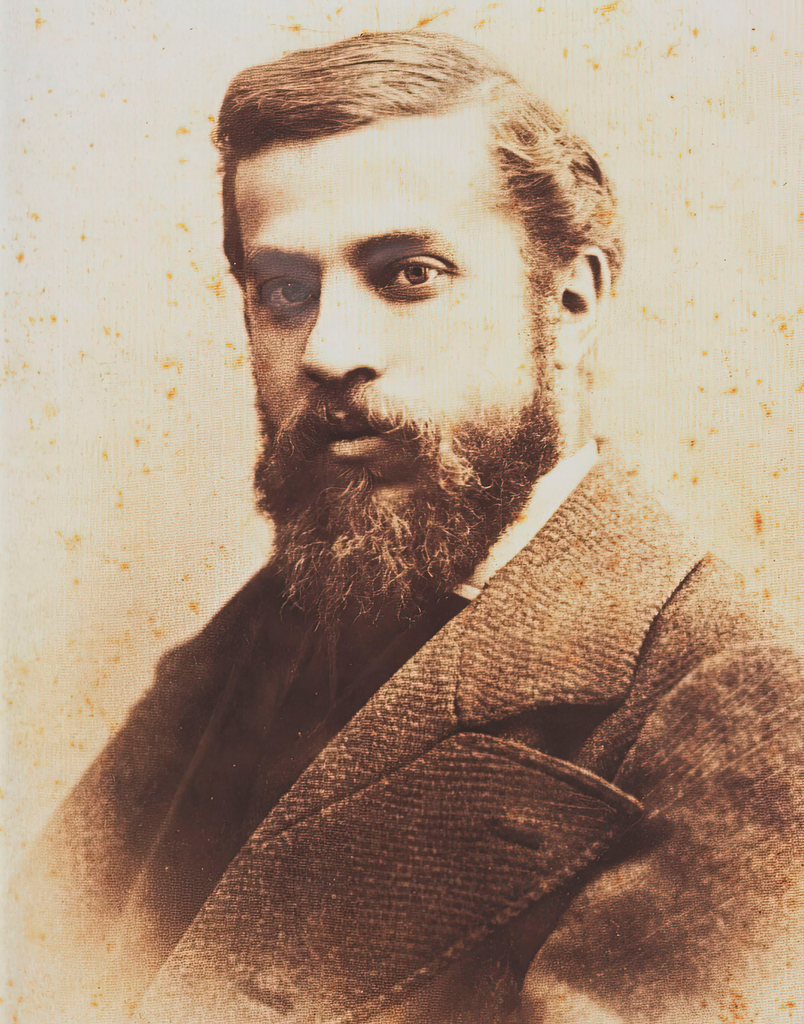
Antoni Gaudí i Cornet
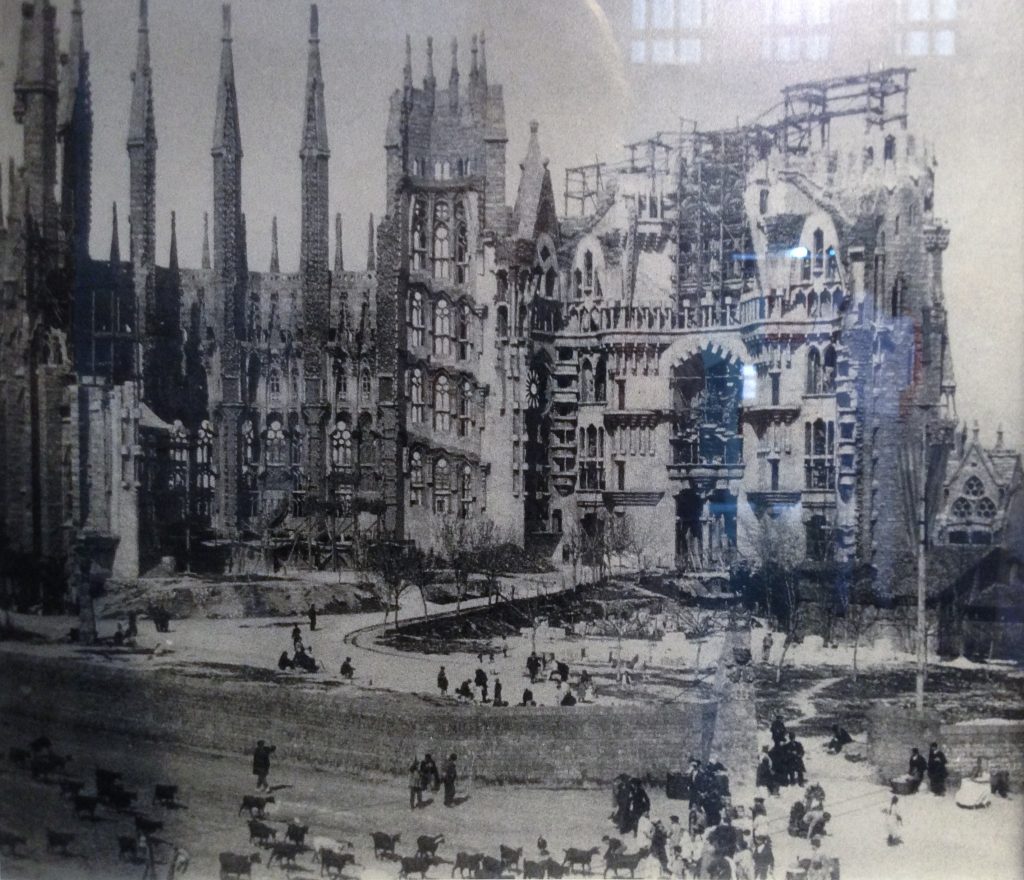
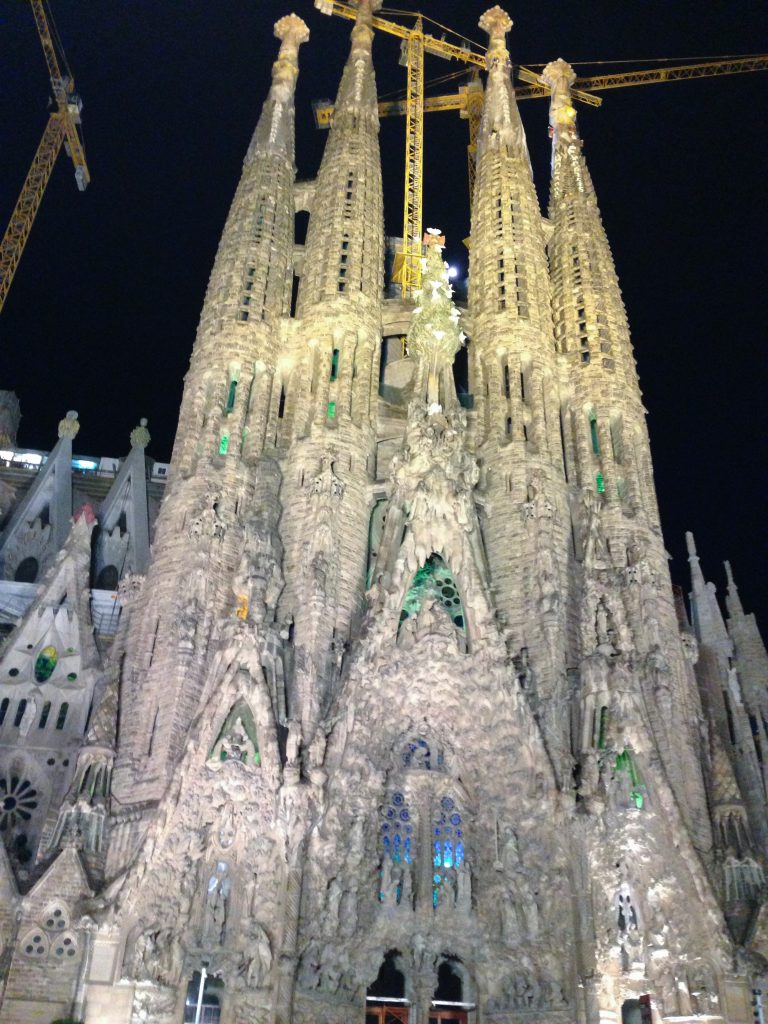
Antoni Gaudí i Cornet
A Penta and WA Reading
Born 25 June 1852, 09:30 local time, Reus, Catalonia. Died 10 June 1926, Barcelona. Emotional Manifestor. Profile 1/3, the Investigator and the Martyr. Split definition, small. Solar Plexus authority. Strategy: inform, then initiate. Theme: peace, and its shadow, anger. Incarnation Cross: Right Angle Cross of Service 2, gates 17 and 18 over 52 and 58. Channels: 16 and 48, the Wavelength. 18 and 58, Judgment. 37 and 40, Community.
Stefani Peter · Creative Artutopia · artutopia.ca
Why read a dead architect for business
Because the chart of a man who is finished with living is the only chart that cannot argue back. Everything Gaudí was going to do, he did. The record is closed. So when the mechanics say one thing and the biography says the same thing in a different language, we are not flattering anyone and we are not guessing at potential. We are watching a design run its full course, from the first commission to the last day, and we can check it against what actually happened.
This is the reason BG5 keeps historical charts on the table. A living client hears “you have no Gate 14” and immediately wants to fix it. Gaudí cannot fix anything. He simply shows us what a life looks like when the resource gate is absent and the vision gate is doubled, and how the world arranges itself around that absence.
There is a second reason, and it is closer to home. Gaudí was a Manifestor running a workshop, an artist with a patron, a man who never once in his career held what we would now call a corporate seat, and who nonetheless left behind a body of work that a hundred years later still employs hundreds of people. That is a business question, and BG5 is built to answer it.
Part One: The Innovator and the Penta
The Penta is the trans-auric body that forms when three to five people work together. It is generative by nature. It reaches into each chart present, takes twelve gates, ignores everything else about the person, and homogenises the group into one unit pointed at the material plane. Its purpose is single and unsentimental: material success. It is built for Builders. Generators and Manifesting Generators sit inside it and feel fed by it, because the Penta runs on Sacral fuel and they are the fuel.
The Innovator, the Manifestor, is not an energy type. The Penta cannot use a Manifestor the way it uses a Builder, and the Manifestor cannot draw sustenance from a field designed to consume response. Placed inside a Penta as one of the working bodies, a Manifestor experiences the field as restriction. The teaching says “uncomfortable and restricting” and that is accurate but too polite. What actually happens is anger, which is the Manifestor’s not-self theme arriving on schedule.
Here is where the standard teaching gets misread. It is heard as an exclusion, as though the Manifestor has been shut out of the small business. What it actually describes is a position. The Advisor, the Projector, stands outside and above the Penta as the Alpha, leading, guiding and directing a field they are not inside. The Innovator stands at the front of it, initiates, and hands off. Neither of them belongs inside the working body, and for entirely different reasons: the Projector because they need to see the whole and be recognised for seeing it, the Innovator because they need to begin things and then be left alone.
The Manifestor’s business is initiation. Something did not exist, and now it does, and the world reorganises around it. What happens afterwards, the building out, the staffing, the sustaining, the daily grind of production, that is Penta work and it is not Manifestor work. The Manifestor who tries to stay inside their own creation and run it day by day is the Manifestor who burns down, and the anger arrives first as impatience with staff, then as contempt for process, then as isolation.
So the correct Manifestor architecture in business looks like this. The Manifestor initiates and informs. A Penta forms behind them to carry the work into matter. Someone else, usually a Projector or a strong Upper Penta Builder, holds the group. The Manifestor keeps the right to begin the next thing.
Gaudí lived exactly this architecture, and he lived it without knowing it, which is what makes his chart worth the study.
One more piece before we look at him. Emotional authority in a Manifestor changes the tempo entirely. The pure Manifestor initiates fast, and the world experiences it as a shock. The emotional Manifestor cannot initiate fast without cost, because clarity only arrives across the wave, and the wave takes as long as it takes. What this produces is a person who appears to be slow, deliberating, sometimes maddeningly unhurried, and who then acts with total finality. There is no negotiation after an emotional Manifestor has reached clarity. The decision has already been made in a place nobody else had access to.
Gaudí has a sentence that belongs in every teaching on emotional Manifestors. Asked why the temple was taking so long, he answered that his client was not in a hurry. His client was God. That is emotional authority given a theology.
Part Two: The life, and the way he worked
The son and grandson of coppersmiths, boilermakers, in Reus. He said later that his sense of space came from the workshop, from watching flat sheets of metal beaten into volumes. He did not learn form from a book. He learned it from a hand hitting a surface until it became a curve. He was ill as a child with rheumatism, kept from other children, and spent his time looking at plants and stones.
He qualified as an architect in Barcelona in 1878. The director of the school is supposed to have said at the graduation that they had either just given a degree to a genius or to a madman, and that time would tell. Whether or not the words are exact, the sentiment survived because everyone who met him seems to have felt it.
The same year he made a display case for a glove maker, Esteve Comella, which was shown at the Paris exhibition. Eusebi Güell saw it, asked who had made it, and sought him out. That meeting is the hinge of the entire career. Güell was a textile industrialist with an enormous fortune, a Catalanist, a man of taste, and for the rest of his life he was Gaudí’s patron. The commissions that followed, the Palau Güell, the estate pavilions, the Colònia Güell, the park that was meant to be a garden city and became a park, came from one relationship.
The work: Casa Vicens, El Capricho in Comillas, the Palau Güell, the Teresian College, the Episcopal Palace at Astorga, Casa Botines in León, Bellesguard, Park Güell, Casa Batlló, Casa Milà, the crypt at Colònia Güell, and from 1883 until his death, the Sagrada Família.
Now the working method, which is where this reading is going to earn its keep.
He did not draw. He disliked producing two-dimensional drawings for builders and relied instead on large plaster models, and the Barcelona architect Rafael Gomez-Moriana puts it plainly: Gaudí did not like to draw, he liked to model. For the church at Colònia Güell he built the funicular model, the hanging chain. He drew the plan of the church on a board at one to ten, fixed it to the ceiling of a shed beside the site, hung cords from the points where columns were to stand, and hung from each cord small sacks of pellets weighing one ten-thousandth of the load the arch would carry. Gravity then did the calculation. The whole thing was read upright by means of a mirror and photographs, and it gave him inclined columns, hyperboloids, parabolas, helicoids and conoids, and let him do away with buttresses entirely. Every adjustment triggered an immediate physical recomputation of the optimal form, which is why people now call it parametric design a century before the software. It took him ten years.
Ten years of a hanging model. Hold that number.
He worked on site, in the middle of the trades, deciding as the thing rose. He kept a small circle of collaborators around him for decades: Francesc Berenguer, who never took his degree and who Gaudí is said to have called his right hand, Josep Maria Jujol, Joan Rubió, Domènec Sugrañes. He did not build a firm in any modern sense. He built a workshop with craftsmen in it and gave instructions by hand, by model, by touch.
He was difficult, and the record of the difficulty is well documented. At Casa Milà he overran budgets, altered structure mid-build, and put a column out into the pavement of the Passeig de Gràcia. When he feared the inspectors would order the column cut, he threatened to fix a plaque to it reading that the missing section had been cut by order of the City Council. The Milà family disputed his fees and took him to court. He won, and Roser Segimon had to mortgage the building to pay him 105,000 pesetas, which he then gave away to a religious foundation.
Read that sequence slowly, because it is a whole design in one anecdote. He would not compromise the work. He would not forgive the fee. He would not keep the money.
He became more ascetic as he aged. He fasted through Lent in 1894 to the point where his life was in danger and a bishop had to talk him into eating. He never married. From 1914 he took no other commission and worked only on the temple, living beside it, walking Barcelona to ask for donations because the building was funded entirely by alms and stopped whenever the alms stopped.
On 7 June 1926 he was hit by a tram on the Gran Via. He was dressed so poorly that he was taken for a beggar, carried to the pauper hospital, and not recognised for a day. He died three days later and was buried in the crypt of the unfinished church.
Part Three: The chart as the working world sees it
Emotional Manifestor. Split definition, small. Three channels only, and they tell you almost everything before we get to the group layer.
The 16 and 48 is the Wavelength, the channel of talent. Depth at one end and enthusiastic repetition at the other. This is the mechanism of mastery through practice: a bottomless well of technical depth that expresses itself as skill, and that must be practised or it curdles into inadequacy. He has Gate 48 in Design and Gate 16 in Personality, which is to say the depth is unconscious, it simply is, and the expression of it is where he lived and could feel himself.
The 18 and 58 is Judgment, the channel of correction. Vitality pressing up against the perception of what is flawed. This channel does not experience the flaw as an opinion. It experiences it as a physical wrongness that must be put right, and it has the joy of life underneath it as fuel. Add Gate 17, opinion, at the Personality Sun, and Gate 52 twice, stillness and concentration, and you have a person constitutionally unable to leave a thing that is not yet correct.
The 37 and 40 is Community, the bargain. Aloneness at one end, the family at the other. This is the tribal contract: I will provide, and in return I am part of something. This is the only channel Gaudí has that reaches into the tribe at all, and it is the channel of the deal between the one who gives the resource and the one who does the work.
His Incarnation Cross, the Life Work in BG5 terms, is Service, built from gates 17, 18, 52 and 58. Note what that means. All four gates of his life purpose sit in one and the same OC16 department. There is no scatter in his design at all. His Sun, his Earth, both sides, all four corners of the cross, land in Logic.
Profile 1/3. The first line has to have the ground under it before it will move, so it digs, researches, tests the foundation, and cannot be talked into a leap it has not personally verified. The third line learns by bumping into things, by trial and by error, and treats a failure as information rather than as a verdict. Put them together and you get a person who investigates obsessively and then experiments physically, and the ten-year hanging model is that profile rendered in string and lead shot. It is a first line building certainty and a third line letting gravity make the mistakes so he does not have to make them in stone.
Split definition, small, means a person who is built to be completed by someone else and who feels the incompleteness as a pull toward particular people. In personal life we leave a split alone, because the open space is where the learning is. In business we bridge it deliberately, and hiring or partnering to bridge a leader’s split is a working strategy. Nobody arranged Gaudí’s bridge on purpose. Güell arrived and it happened anyway.
Environment reads as narrow valleys, and style observed. Touch cognition. A man who takes in the world through his hands, in a confined space, while being watched. He built in the dense grid of the Eixample and in the folds of Catalan hillsides, worked in plaster and clay and broken tile, and spent the last decade of his life as the most looked-at man in Barcelona.
Part Four: The Power Base, where his authority gathers
First the caution that must always come before the numbers. The six percentages do not add to one hundred and they cannot be compared across departments, because each is a fraction of that department’s own size. Competitiveness holds four gates, so a single activation there reads as twenty-five percent. Logic holds sixteen, so a single activation reads as six. The number is a shape, not a score.
Total percent counts every activation, including repeats, and reads as intensity. Active percent counts distinct gates only and reads as breadth. When the two numbers sit far apart, few gates are being struck hard and repeatedly, and the influence is concentrated and deep. When they sit level, the presence is broader and lighter.
| Department | Channel | Total | Active |
|---|---|---|---|
| Logic | 50 and 27 | 87.5 | 62.5 |
| Direction | 2 and 14 | 50 | 37.5 |
| Innovation | 3 and 60 | 40 | 30 |
| Competitiveness | 25 and 51 | 25 | 25 |
| Management | 45 and 21 | 20 | 20 |
| Interaction | 59 and 6 | 6.25 | 6.25 |
Fourteen of his twenty-six activations land in Logic. Ten of the sixteen Logic gates are lit: 17, 18, 16, 27 three times over, 52 twice, 58 twice, 48, 15, 31 and 63. This is not a preference. This is where a life happened.
Logic, and the fierce mother
Logic in the WA is the department of preservation, standards, and values. Its keynote is the protection of the group through correctness. It senses what is off before anyone can articulate it and it is willing to say so. It spots the weak link in the process before the weak link costs money. It sets the rhythm, the review cycle, the standard of the work. Its channel, 50 and 27, is the fierce mother: caring that has teeth in it.
Gaudí carries Gate 27, caring, three separate times, in three different lines. Nothing else in his chart is repeated at that intensity. Gate 27 is nourishment, the feeding of what is in one’s charge, and in the organizational field it is the willingness to take responsibility for the wellbeing of the whole. Three activations is a person who cannot put a thing down once it belongs to him.
Read the biography against that. He took over the Sagrada Família at thirty-one and he did not leave it for forty-three years. From 1914 he refused every other commission. He lived on the site. He walked door to door begging money for a building he knew he would not see finished, and he was still doing it at seventy-four in clothes so worn that a hospital took him for a vagrant. That is Gate 27 with nothing to check it. He mothered a building.
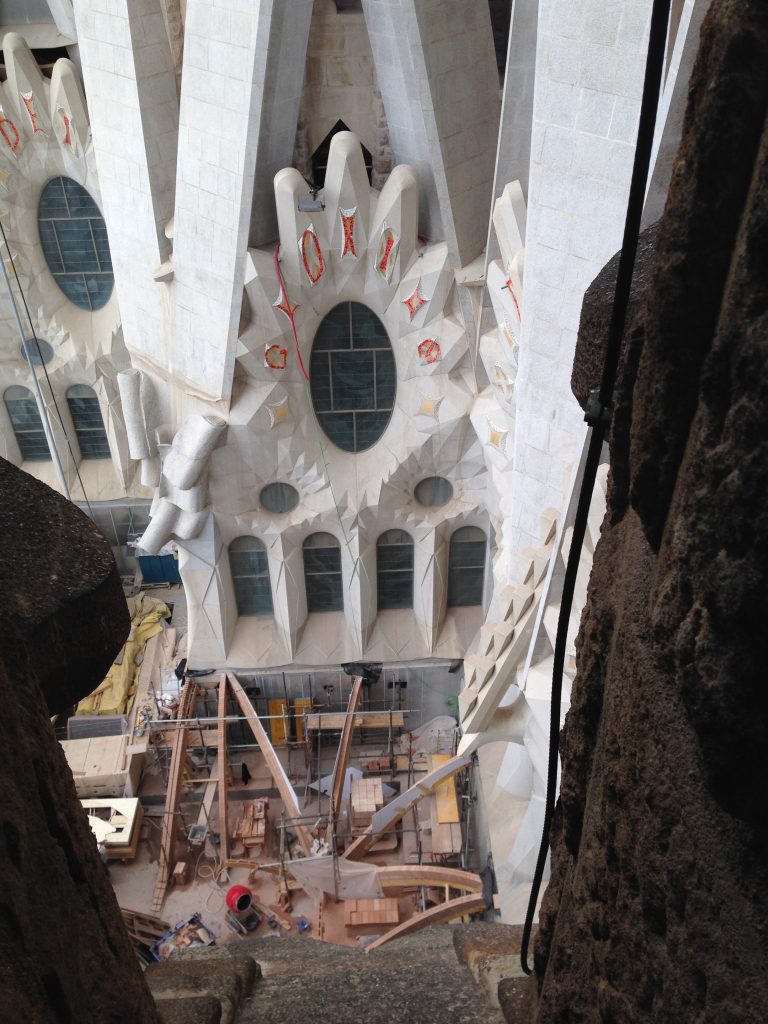
The healthy expression of a strong Logic base is the guardian of standards. It protects the culture through what it will and will not accept as good enough. It trains people. It builds mastery in others by holding a line. Gaudí’s workshop produced a generation of Catalan architects and craftsmen who had learned to work at a standard they could not have reached alone, and the trencadís, the broken tile mosaic, only exists because someone insisted that discarded ceramic could be brought up to a standard rather than thrown away.
The shadow of a strong Logic base is safety through control. It corrects because it is anxious rather than because the thing is wrong. It enforces standards nobody explicitly agreed to. It becomes the nervous system of the whole company and then resents carrying it. Gaudí’s shadow is documented in the court records. A column that overhangs the pavement is a correctness he decided on alone and then defended against the city with a threat. The Milàs were not wrong that the budget had run away from them. He was not asking. He was enforcing.
The mastery of this department is stated in one line in the source material and I have never found a better one: communicate as the guardian, not as the judge. The difference is not in the content of what is said. It is in whether the person on the receiving end feels protected or feels sentenced. Gaudí, on the evidence, spent his working life on the judge’s side of that line with clients and on the guardian’s side with craftsmen. His workmen loved him. His clients sued him.
And the last thing about his Logic: his Incarnation Cross lives here. The Cross of Service, gates 17, 18, 52 and 58. In BG5 the Incarnation Cross is the Life Work, the alignment of purpose with the working life. His purpose gates are opinion, correction, stillness and vitality, and every one of them sits inside the department of standards. A man whose life work was to see what was wrong, hold still with it long enough to understand it, and put it right, in the service of something larger than a client.
Direction, and the missing half
Direction is the department of the 2 and 14, and it is the only channel shared by the Penta and the WA. It is the backbone, the place where money joins planning. Gate 14 gathers the resource, Gate 2 decides where it goes. The department also holds 61, 24, 43, 23, 8 and 1.
Gaudí has Gate 2 twice and Gate 43 and Gate 1. He has no Gate 14 at all.
This is the sharpest finding in the entire reading, so let us be exact about it. Gate 2 is the Keeper of the Keys, the direction, the knowledge of where the resource ought to be pointed. Doubled, in his chart, on both sides. He knew where value should go with an authority that never wavered for fifty years. Gate 43 is the insight nobody else has yet, the knowing that arrives whole and cannot be explained until later. Gate 1 is the creative self-expression that makes people want the thing.
And no Gate 14. No engine. The teaching on the missing 14 is that the work stalls at every launch, that money insecurity becomes chronic, and that the person waits to be rescued.
The Sagrada Família stopped every time the alms stopped. It was, from the beginning, an expiatory temple funded by donations, which is to say it had no capacity gate of its own either. He did not build a business that generated money and then directed it. He directed money that other people generated. Eusebi Güell was the capacity. When Güell’s support was there, the work moved. When a client generated the money, as the Milàs did, the direction and the capacity went to war and ended in court.
The Direction reading is therefore precise and unsentimental. He was a man with total clarity about where resources should flow and no mechanism at all for producing them. In a large organization that person is invaluable and dangerous in equal measure, and must be paired, structurally and permanently, with someone who holds Gate 14. He was. His name was Güell, and the pairing lasted until Güell died in 1918.
Innovation, the pulse
Gate 3 twice, Gate 38, Gate 39. No Gate 60.
The 3 and 60 department is mutation and the pressure to change. It senses when a system has gone stale and it pushes the group to risk becoming something new before safety is guaranteed. Gate 3 alone is the mutative pulse without the containment of limitation. Gate 60 is the discipline of the constraint, the acceptance of the boundary within which the new thing must appear. He has the pulse and not the boundary, and the boundary came from outside: from budgets, from city ordinances, from the physics of stone, from a client’s patience running out.
Gate 38 is the fighter, the one who knows what is worth struggling for. Gate 39 is provocation, the energy that pokes at a thing until it releases what it is holding. Together with the doubled 3, this is a man who will not accept the existing form of anything and who has the stamina to fight about it for decades.
The shadow of this department is that it burns out or turns rebellious when it is managed too tightly. Gaudí’s response to being managed tightly was the plaque he threatened to bolt to a column. That is Gate 39 provoking and Gate 38 refusing, in public, on the most expensive street in Barcelona.
The mutation itself is real and it is his legacy. He did not improve an existing architecture. He broke the pattern of load-bearing masonry that had held in Europe for eight hundred years, and he did it with string and lead shot in a shed.
Competitiveness, one gate
Gate 51 alone, no Gate 25.
The 25 and 51 is Competitiveness, the initiation channel, the shaman. It leads by going first, taking the shock, and coming back changed. Gate 51 without Gate 25 is the compulsion to be first without the innocence and universal love that gives the shock its meaning. I say plainly that this is one of the two channels the source decks never fully covered, authored from the keynotes rather than transcribed, so read it as living teaching rather than as scripture.
Gate 51 is the arousing, the thunderclap, the shock that wakes people up. A quarter of a small department is not much on paper, and it is exactly what Gaudí’s work does to people who see it for the first time. Casa Milà was mocked when it went up. The Sagrada Família has never once been received calmly. He went first, alone, without a school behind him and without followers who could carry the style, and he took the shock personally in the form of ridicule for most of his career.
And there is the last day. Struck down in the street by a tram, unrecognised. Gate 51 in its rawest form. I do not offer that as mechanics. I offer it as the kind of rhyme that this work keeps producing.
Management, the bargain without the throne
Gate 37 and Gate 40, which is his Community channel, and nothing else. No 45, no 21, no 54, 32, 44, 26, 19 or 49.
The 45 and 21 is Management, the money line, the King and the Queen, the department of stewardship and CEO energy. Gaudí has none of it. What he has instead is the tribal bargain in its purest form: 37, the hand extended, and 40, the aloneness that does the work and then withdraws.
This is the Güell relationship written into the chart. Not employer and employee, not chief executive and staff. A bargain. You provide, I build, and neither of us pretends to manage the other. It is also the reason there is no Gaudí firm, no Gaudí practice that outlived him, no institution with his name on the door. He had no channel for stewardship over a large body of people and he never attempted one. Everything he built structurally, as opposed to architecturally, was a workshop of craftsmen inside a patron’s money.
This is not a gap in him. It is simply not where he leads. It is precisely what he brought other people in for, and the fact that he did it by instinct rather than by design does not make it less correct.
Interaction, almost empty
One gate out of sixteen. Gate 56, the storyteller.
The 59 and 6 is Interaction, the department of intimacy, of aura-busting, of the glue and the engine of an organization. It is commitment to the shared experience of the work, the bonding that makes a group want to be a group. Gaudí has one gate in it, and it is the gate of the wanderer who tells the story of what he has seen.
He never married. He had one recorded attachment, to a teacher at Mataró, which did not go anywhere. He kept a small unchanging circle for forty years and let almost nobody else in. He did not do the intimacy layer of business at all. He did not charm clients. He did not build a network. He did not maintain relationships as an activity separate from the work.
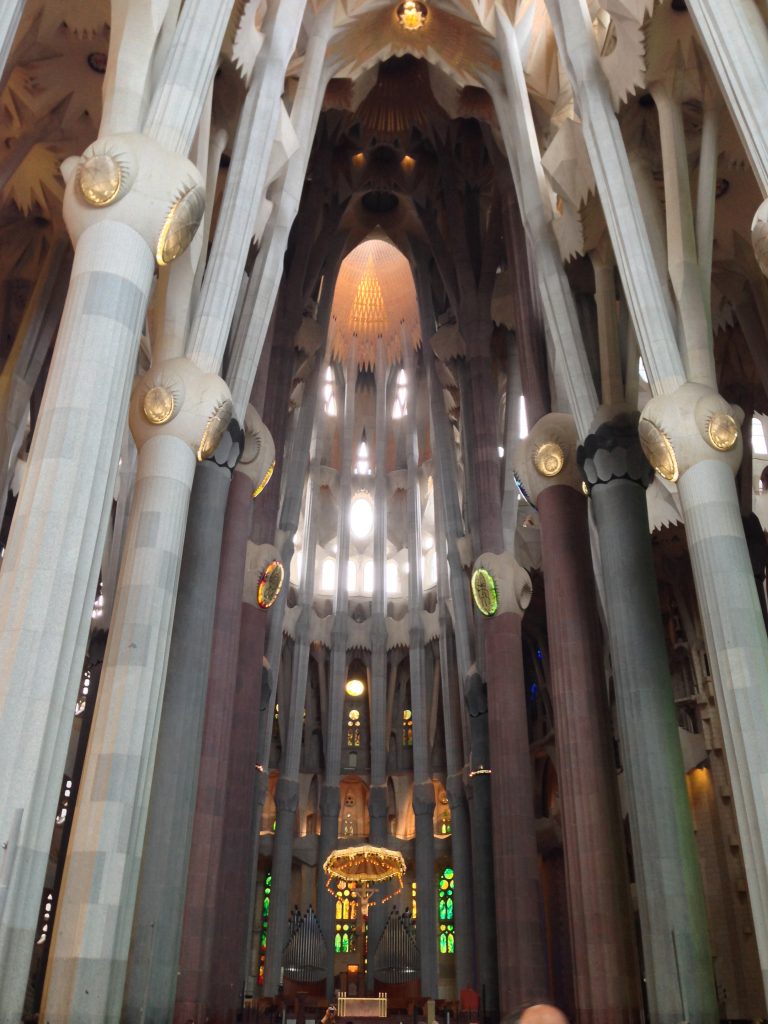
What he did instead is Gate 56 in its highest form. He told the story in stone, so that a person who never met him and does not share his faith walks into the nave and understands something wordlessly. He did not bond with people. He built something that bonds people to each other. Twenty million a year come to stand inside it.
The channels, and the doorway
Four hanging gates and not one full organizing channel. Gate 3 without 60. Gate 27 without 50. Gate 2 without 14. Gate 51 without 25. Interaction and Management have neither gate at all.
A full organizing channel is designed leadership in that stream, and it runs whether the person cooperates or not. A hanging gate is different, and this is the mechanism worth understanding properly, because it explains almost everything about Gaudí’s uneven career. With a hanging gate, the Wall turns on through recognition. In a room where the person is not seen, the gate stays a private pressure and drains them. In a room where they are recognised, the whole authority comes on at once and the person becomes, for that period, unmistakably the one who leads.
Test it against his life. In front of the Milàs, in front of the municipal inspectors, in front of the Barcelona press that called his building a stone quarry, none of it turned on. He was obstinate, expensive and impossible. In front of Güell, in front of his craftsmen, on his own site, all of it turned on, and men who had every professional reason to resist a fanatic instead followed him for decades.
So the honest line for this chart, and it is the same line the earlier reading found: the Wall stayed a doorway rather than a throne. He was never going to run an organization of sixteen or more. He was going to stand in the opening of one, and the thing he initiated would gather the sixteen behind him and keep gathering them for a century after he stopped standing there.
Part Five: The Penta, the twelve roles
Now the small group. Of the twelve Penta gates, Gaudí carries four: 31, Administration. 1, Implementation. 15, Reliability. 2, Vision, twice.
Not one of them closes into a channel. Gate 31 without Gate 7. Gate 1 without Gate 8. Gate 15 without Gate 5. Gate 2 without Gate 14. Four roles, four open hands, four places where another person had to arrive.
What he carried
Gate 31, Administration. The Upper Penta gate that puts the plan into action and keeps everyone on task, the voice the group looks to. He has it, and every account of him on site describes exactly this: the one voice, directing the trades, deciding in the moment, holding the whole build in his head.
Gate 1, Implementation. The creative expression that makes people want the thing. Gate 1 in the Penta is sales, in the deepest sense: not persuasion but the emanation of something so alive that people move toward it. He had it at the Personality Sun’s opposite pole and he used it exactly once in the way business uses it, when a glove maker’s display case caught the eye of the richest patron in Catalonia. One vitrine, one commission, forty years of work.
Gate 15, Reliability. The aura that pulls a group into a cohesive team, the extreme of the human that others organise themselves around. His workshop held together for decades around a man who paid badly, worked constantly, and asked everything. That is Gate 15 doing what it does.
Gate 2, Vision, twice. Direction. Where the money should flow. Doubled in his chart. Nobody who reads his career can miss it. He always knew where the value was, and he was almost never wrong, and he was routinely years ahead of the people paying for it.
Notice the architecture. Two Upper Penta gates, 31 and 1, and two Lower, 15 and 2. The three Upper channels run from the G Center to the Throat, and Upper Penta people are managed by being handed an outcome and left alone. The three Lower channels run from Sacral to G, and Lower Penta people need the task assigned, the steps laid out, feedback, and someone checking the work. Get this backwards and you produce a resentful Upper and a floundering Lower.
Gaudí is Upper in his direction and Lower in his resourcing, which is an unusual and rather beautiful split. Hand him the outcome and go away, and he will produce something nobody asked for and everybody needed. Ask him to generate his own money and his own team culture, and the mechanism is not there.
What he did not carry, and who supplied it
Eight roles missing, and the biography reads like a case study for each one.
No Gate 7, Planning. The pair to his 31. He had the administration and no future planning, which the teaching describes as reactive rather than forward-creating. He worked on a building with no completion date and no schedule, changing the design as it rose. Modern architecture has spent a century trying to reconstruct what he intended, because the plan existed in a man’s head and in plaster, and most of the plaster was smashed in 1936. He administered magnificently and he never once planned.
No Gate 8, Public Relations. The pair to his 1. He could implement, and the work could not get itself in front of the right people. He never publicised, never courted the press, never explained himself. Every single commission he received came through personal introduction, and almost all of them through one man. The teaching line is that the work never reaches the right hands, and here it is precise: the work reached one pair of hands, and Gaudí spent his career inside them.
No Gate 33, Oversight. No institutional memory, no learning from the past carried forward as a system. He fought the same fight over budget, over ordinance, over patience, on project after project, and the fight never got easier because nothing was ever written down as a lesson.
No Gate 13, Accounting. No record. With 33 and 13 both gone, the group has no memory at all. Almost everything we know about how he worked has had to be reconstructed from photographs, fragments, and the recollections of men who were there. He kept no archive. He set down no method. A man who invented a design technique that anticipated computational architecture by a hundred years left behind almost no documentation of it.
No Gate 5, Culture. The pair to his 15. He held people by his aura and never built a “how we do things here” that could survive him. There is no school of Gaudí. Jujol and Berenguer and Rubió went on to their own work; nobody carried a method forward, because there was no method to carry, only a man.
No Gate 14, Capacity. Already said, and worth saying twice. The resource engine was absent and the resource came from outside every single time.
No Gate 46, Coordination. The bringing of a group into one cohesive body. The teaching line is blame, cliques, control from the top, nobody relaxing. He controlled from the top for forty-three years.
No Gate 29, Commitment. This one is a genuine surprise and it needs stating carefully, because Gaudí is the most committed man in the history of European architecture and he does not have the commitment gate. What the gate actually governs is the group’s shared commitment, the loyalty of the team achieving as one. Its absence shows as the leader dragging everyone alone. He was not dragged. He dragged. His commitment was total and it was entirely personal, and it did not transmit into a team that would carry it as its own.
Four gates present, eight absent, no channel closed. A Manifestor with no Penta channel is not a failing. It is the mechanics telling you what the teaching already said: he was never designed to sit inside the small working body. He was designed to initiate, and to be completed from outside.
And he was completed from outside. Güell brought the Capacity. The craftsmen brought the Coordination and, in the way of a good site, the Culture. The Church and the devout of Barcelona brought the Commitment that funded the alms year after year. The building itself has become the Public Relations, and it did so forty years after his death.
Part Six: The three channels the group field never looks at
Everything we have done so far has been the group’s reading of him. The Penta reaches into a chart, takes twelve gates, and ignores the rest. The Wall reaches in for six channels and ignores the rest. Both of them are honest about this. They are not interested in the person. They are interested in what the person can do for the material plane.
So it is worth stopping and asking what exactly they ignored in Gaudí, because in his case the ignored part is the part that built Barcelona.
He has three channels. Not one of them is a Penta channel. Only one of them, the 37 and 40, contributes so much as a gate to the Wall. By the arithmetic of the group field he is close to invisible, and yet these three channels are the entire apparatus of an artist, and they are worth reading in their own right before we hand him back to the business layer.
16 and 48, the Wavelength, and the fact that it is his only voice
Depth at the splenic end, expression at the Throat. Gate 48 is a well without a bottom, and it does not feel like a gift from the inside. It feels like inadequacy, the permanent sense that one does not yet know enough, and the only thing that ever quiets it is practice. Gate 16 is the enthusiasm that repeats the thing until the repetition turns into skill. Together they are talent, which in this circuit means competence achieved by doing it ten thousand times, not brilliance arriving unearned.
Now look at where this sits in his design. The 16 and 48 is his only route to the Throat. He has no other channel that reaches expression. Everything Gaudí ever communicated had to pass through the gate of talent to get out of him.
That is not a metaphor. It is a mechanical description of a man who could not sell, could not charm, could not explain himself to a committee, could not write a manifesto, and whose entire capacity to be understood depended on the object being demonstrably, undeniably well made. Put him in a room to argue and he lost. Put him on a site with material in his hands and nobody argued.
And Gate 48 is in the Design, unconscious, which means the depth was never available to him as reassurance. He could not feel how good he was. He could only keep going back to the work.
18 and 58, Judgment, and the aesthetic that has teeth
Vitality pressing upward into the perception of the flaw. Gate 58 is the joy of being alive, and it is a pressure, which is the part people forget. It presses toward improvement because improvement is where the aliveness goes. Gate 18 receives that pressure and finds what is wrong with the existing pattern.
This is the artist’s eye, described mechanically. Not taste, which is preference, but correction, which is the physical inability to leave a wrong proportion alone. The 18 does not have an opinion about the flaw. It sees the flaw the way one sees a colour.
In him this channel carries two of the four gates of his Incarnation Cross, so the correction is not a habit, it is the life work. And underneath it sits Gate 17, opinion, at the Personality Sun, and Gate 52 twice, stillness. He is built to see what is wrong, to hold absolutely still with it, and to form the view that will put it right.
Every account of Gaudí on a building site is this channel in operation. The column that must go where it must go. The budget that gives way to the proportion. The ten years of the hanging model, which is the 18 refusing to accept an arch that has not proved itself, with the 58 supplying enough sheer vitality to keep restringing it.
37 and 40, Community, and Worship
And here, as you say, everything gets clear.
Gate 40 is the aloneness of the one who does the work and then withdraws, the deliverance, the hand that provides. Gate 37 is the hand extended, the bargain, the warmth that binds a family into a body. You read the 37 as the gate of Worship, and once that is on the table the whole of Gaudí falls into place, because worship is what a bargain becomes when the other party is not a person.
He was asked why the temple was taking so long and he said his client was not in a hurry. That is the 37 and 40 naming its counterparty. The bargain, the tribal contract at the root of all commerce, I provide and in return I belong, was made by Gaudí with God. Not with a company. Not with a market. He held up his end for forty-three years, alone, in the 40, and the warmth of the 37 went upward.
This is why he could not be managed and could not be paid off and could not be shamed by the Barcelona press. None of them were party to the contract.
Now put that beside the doubled Gate 2, Vision, the direction, the knowledge of where the resource should flow. Worship joined to direction. Every peseta, every hour, every craftsman, every stone, pointed at one place, and the place was sacred. He won a fee in court and gave it to a convent, which looks like eccentricity until you see the 2 and the 37 in the same chart, at which point it is simply the resource going where it was always going to go.
And there is no Gate 14. No engine. Worship and Vision and no Capacity is the design of a conduit: a person who knows exactly where value belongs and has no apparatus for producing it, so it has to arrive through him from elsewhere. Through Güell. Through the alms box. Through the coins of people who had almost nothing and gave anyway.
What this says about reading artists for business
The Penta took four gates from Gaudí and ignored the three channels that made him an artist. That is not a failure of the model. It is the model telling the truth about itself. The group field is not interested in artistry. It is interested in whether the work can be administered, sold, recorded, resourced and coordinated.
Which is precisely why an artist needs the business reading and cannot be read by it alone. Run the Penta on Gaudí and you find a man with four hanging gates who cannot plan, cannot publicise, cannot account and cannot resource. All true, and all of it correctly answered by the presence of one patron. Then read the three channels the Penta discarded and you find talent, judgment and worship, which is the whole of him.
The instruction that comes out of this for a living artist is simple and worth saying to every client. Do not hire yourself into the roles the Penta finds missing. Hire other people into them, and protect the channels the Penta cannot see, because those are the ones nobody else can supply.
Part Seven: Where the chart and the life meet
Six places where the mechanics and the biography say the same thing in different languages.
The ten-year hanging model is a 1/3 profile with 87.5 percent Logic. No other configuration produces that behaviour. The first line will not proceed without verified foundation. The third line insists on learning by physical trial. Logic at that concentration cannot leave a thing that is not yet correct, and Gate 52 twice supplies the stillness to sit with an unfinished thing for a decade. He did not choose that method. He was that method.
The refusal to draw is Touch cognition and a coppersmith’s hands. Drawing is abstraction. He took the world in by touch and gave it back as volume, in plaster, clay, string and broken tile. Asking Gaudí for a plan set is asking a man to work through a sense he did not lead with.
“My client is not in a hurry” is emotional authority. A Manifestor with Solar Plexus authority cannot rush and stay correct, and Gaudí built a theology around the wait. He also modelled the Manifestor strategy exactly: inform, then initiate. He told people what he was going to do. He did not ask them, and he did not stop when they objected.
The Milà lawsuit is the Manifestor theme in three acts. Anger at being obstructed, which is the not-self of the type. Total refusal to compromise the work, which is Logic in its enforcing shadow. And then giving the money away, which is Gate 14 absent: the resource was never the point, and he had no mechanism for holding it anyway. A man with Gate 14 wins that case and reinvests the money.
The Güell relationship is 37 and 40 bridging the Direction gap. The only tribal channel he has is the bargain. The only thing missing from his backbone is Capacity. Güell supplied it, and the arrangement was never management, always a bargain between two men who each held a half.
And the ending is a hanging gate that never became a throne. He gave forty-three years to a building nobody had commissioned him to finish, funded by coins collected door to door, and died anonymous in a pauper’s ward two blocks from it. Then the doorway he was standing in kept gathering people. There are more workers on the Sagrada Família now than he ever employed, and the field he initiated has outlasted every organization his contemporaries built with proper management channels and proper capacity and proper plans.
That is the Innovator’s business, precisely as designed. He did not run the thing. He started it, and it has not stopped.
What this reading is for
Gaudí is here for the living. Manifestors arrive at a business reading already braced, waiting to be told they do not belong in a team, and they hear that as a verdict on their character. What the mechanics describe is a place to stand. The Innovator begins something and hands it on, and the handing on is the professional skill, not the defeat.
And to any client sitting in front of a chart with hanging gates and no closed channel, low percentages, nothing that looks like leadership on paper, Gaudí is the answer. He had four Penta gates out of twelve, no Penta channel, no organizing channel, an almost empty Interaction, and no Management at all. On a spreadsheet he is unremarkable. What he had was one department lit like a furnace, one relationship that supplied what he lacked, and the willingness to stand in the doorway for forty-three years.
The Power Base does not measure how much of the world a person can hold. It shows where their authority switches on, and who has to be standing next to them.
He carried the vision and never the purse, so the world sent a patron, and the stone did the rest.
Stefani Peter · Creative Artutopia · artutopia.ca
