What Human Design Is, in Simple Words
Human Design for Beginners I
A simple first guide to who you are
An introduction to Type, Strategy, Authority,the body’s signposts, and the centres that shape a life
Human Design is a map of how you are built to make decisions and live your life. It does not tell you what to do or who to become. It just describes how your own nature already works, so you can stop fighting yourself and start trusting your own body.
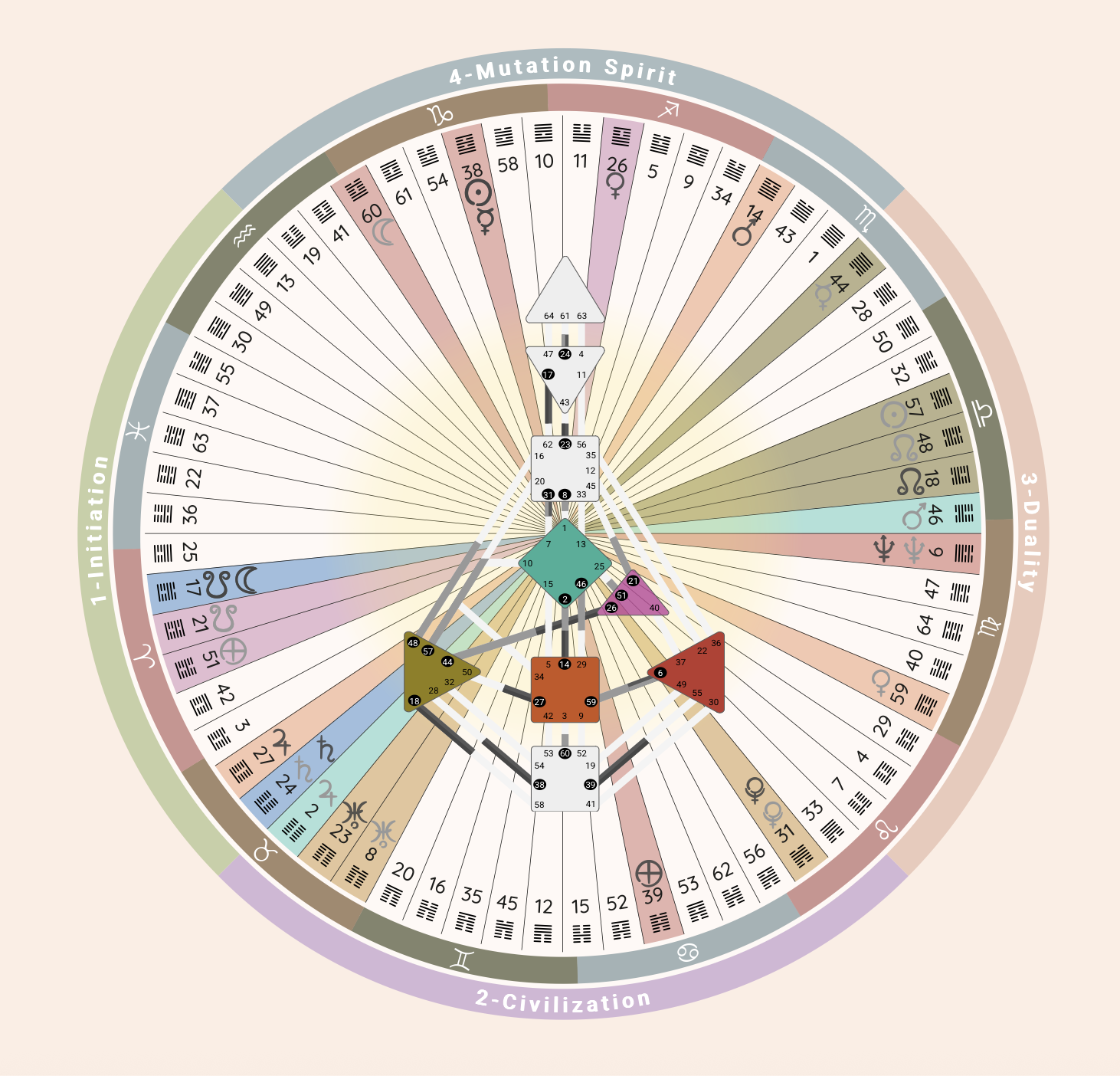
The map comes from your birth: the date, the exact time, and the place where you were born. From that, a chart is made. It is a picture of your energy. People often call it a bodygraph, because it looks like a body with centres, channels, and gates marked on it. Some parts are coloured in and some are left white. Those two simple states, coloured and white, hold most of what a beginner needs to know.
The basic idea is simple and practical. Most of us were taught to live from the mind, to weigh every option and think our way to the right answer. Human Design suggests something quieter. It says the body has its own kind of knowing, and that life works better when you learn to notice that knowing and follow it.
Ra Uru Hu, who first taught this system, made one point over and over. The mind is great for thinking, talking, and understanding the world. It was never meant to run your life. When you let the body lead instead, life feels less like a struggle.
So read this little book lightly. You do not have to believe anything. You are just being invited to try it out, watch your own life, and notice what feels true when you live it. That is the whole method. The rest is just vocabulary.
The Bodygraph: Your Chart at a Glance
When you make a Human Design chart, you get a picture with nine shapes inside it. These shapes are the centres. They are joined by lines called channels, and small points along those lines called gates. For now, the gates and channels can wait. The nine centres, and whether they are coloured or white, already tell you a lot.
Each centre handles a certain kind of energy or awareness. One holds your identity and direction. One holds how you communicate. Others hold your gut response, your emotions, your intuition, and your willpower. Together they make up the different parts of you.
What makes the chart yours is the pattern of colour. Some centres are coloured in, which means they work in a steady, consistent way that belongs to you. Others are left white, which means they are open. Open centres take in the world around you and respond to it. Neither one is better than the other. Your life is shaped by your own mix of the two.
This is the real gift of the chart. It shows you, without judgement, where you are steady and where you are open. Once you can see that clearly, a lot of old confusion about yourself starts to ease.
The Nine Centres
Before we look at the colour, it helps to meet the nine centres. You do not have to memorize them. Just let them become familiar over time.
The Head Centre sits at the top. It holds mental pressure, the pressure to wonder, ask questions, and get inspired. This is where ideas first land.
The Ajna Centre is where you think things over and make sense of them. It holds the way your mind works through what it takes in.
The Throat Centre is where you express yourself and get things done. It turns energy into speaking and action. Most of the chart wants to reach the throat to be said or done.
The G Centre sits in the middle. It holds identity, love, and direction, your sense of who you are and where your life is going.
The Heart or Ego Centre is small but strong. It holds willpower, self-worth, and the drive to make and keep promises.
The Solar Plexus Centre holds emotions, moods, and desire. When it is coloured, feelings come in waves that rise and fall, and clarity takes time to arrive.
The Sacral Centre is the engine of work and life energy. It holds the gut’s deep yes and no, and the steady energy to keep building and creating.
The Spleen Centre holds intuition, instinct, health, and your sense of safety in the moment. Its signal is quiet and quick, and it usually speaks just once.
The Root Centre sits at the bottom. It holds drive, stress, and the pressure that gets things moving.
Nine centres, nine kinds of energy. Some will be coloured in your chart and some white, and that pattern is where the real reading starts.
Gates and Channels
The centres are joined together. The lines between them are called channels, and the small points along those lines are called gates. Together they are the wiring of the chart, the way energy moves from one centre to another.
A gate is a single point on the edge of a centre. It stands for one specific theme or gift. There are sixty-four gates in all, based on the old I Ching, and each one has its own flavour. You can think of a gate as one note.
A channel is a bridge between two centres, made of two gates, one at each end. When both gates are switched on in your chart, the channel is complete, and energy flows steadily between the two centres it joins. There are thirty-six channels in all, and each one adds a steady part to the person who has it.
This is also how a centre becomes defined. A centre fills in with colour when at least one complete channel reaches it. So the channels are what create your pattern of defined and open centres. The coloured gates and channels are the steady parts of you. The empty ones are the open parts.
You do not need to learn the sixty-four gates or thirty-six channels to start. They are there for later, once Type, Strategy, and Authority feel familiar. For now it is enough to know what they are.
Defined and Open Centres
This is one of the most useful ideas in the whole system, and it is easy to get in one sitting.
A defined centre is coloured in. It carries a steady, reliable energy that is always there. It does not depend on anyone else. Because it is steady, you can count on it, and other people can feel it too. A defined centre is a part of you that stays consistent wherever you go. It is your solid ground.
An open centre is left white. It does not make its own steady energy. Instead it takes in the energy of the people and places around you. An open centre is actually wise, because over a lifetime it samples so much. It is also where you pick up the most conditioning, where you take on pressure and treat it as your own.
A defined centre is like a radio station that always plays the same clear signal. An open centre is more like an empty room. It has no sound of its own, but it fills up with whatever comes in. That isn’t a weakness. Open centres are built to take things in, feel them, and get wise about them over time.
A lot of early confusion in life comes from the open centres, because we treat their borrowed energy as our own and try to be steady where we are meant to be open. It is a big relief to learn that an open centre was never meant to be reliable. It was meant to take in the world and get wise. Seen this way, the open centres are not flaws at all. They are wide doorways to something bigger than you.
So when you look at your chart, start here. Notice which centres are coloured and which are white. The coloured ones are your steady ground. The white ones are where you learn, feel, and grow wise. This one observation already changes how you understand yourself.
The Motor Centres
Of the nine centres, four are motors. A motor is a centre that makes energy, a power source that can drive activity and keep the body going. Knowing which centres are motors helps you see where the real power in a chart comes from.
The four motors are the Sacral, the Heart or Ego, the Solar Plexus, and the Root. Each one makes a different kind of fuel.
The Sacral is the big life-energy motor, the renewable energy for work and creating. It is the only motor that can keep up steady, day-to-day effort without burning the body out. That is why the types with a defined Sacral are the workers and builders of the world.
The Heart or Ego is the willpower motor. Its energy comes in bursts, not a steady stream. It fuels promises, commitments, and the drive to prove and provide, and it needs rest between efforts.
The Solar Plexus is the emotional motor. Its power is the power of feeling and desire, moving in waves that rise and fall. It does not run on a flat line.
The Root is the pressure motor. It pulses, sending bursts of energy up to get things started and keep them moving. Its rhythm is a series of pushes, not a smooth flow.
Why does this matter? Because energy and awareness are not the same thing. A motor gives you fuel. It does not give you direction. A lot of stress in life comes from running on motor energy without listening to the awareness that should guide it. The motors say go. They never say where. That is the job of your Authority, which we will get to soon.
It also matters because which motors you have helps shape your Type and how decisions come to you.
The Five Types
If you remember only one thing from this book, make it your Type. Ra called Type the most important piece of all. Your Type describes the basic way your energy meets the world, and from it comes your Strategy, the simple habit that keeps you on track.
There are five Types. Each one moves through life with a different energy and rhythm. None is better than another. They are just different.
The Manifestor
Manifestors are the initiators, built to start things. Their energy pushes outward and has an impact. A Manifestor can start things on their own, without waiting for permission, and when they move, other people feel it. Their gift is to get things going that others then carry forward. Because their actions affect everyone around them, they find more peace when they let people know what they are about to do before they do it. This clears the way and lowers resistance. Manifestors are a small part of the population, but they get things started.
The Generator
Generators are the life force of the world and the largest group. They have a defined Sacral motor full of steady energy. That power is huge, but it is not meant to be aimed at everything. It is meant to respond. When something shows up and the gut responds to it, a Generator lights up and can work for hours without wearing out. When a Generator starts things from the mind instead of responding from the gut, the same work drains them. The trick is not to chase. It is to wait for life to bring something, then feel the body respond.
The Manifesting Generator
Manifesting Generators have the Generator’s defined Sacral energy plus some of the Manifestor’s speed. Like all Generators, they respond. But once they are lit up, they move fast, skip steps, do several things at once, and find shortcuts. Their path is rarely a straight line, and that is fine for them. They are built to be fast and good at many things. Their challenge is to respond first instead of leaping, then let others know what they are doing, since their moves affect people too.
The Projector
Projectors are the guides, the ones who see deeply into other people and systems. They do not have a defined Sacral motor, so they are not built for endless work. They are built for insight, for guiding and managing energy rather than producing it without end. The Projector sees others clearly, often more clearly than people see themselves. Because of this, their gift lands best when it is recognized and invited. When a Projector waits for the right invitation, for the people and roles that truly see them, their advice is welcomed and life opens up. When they push for recognition that has not come, they meet resistance and get worn out. The Projector is here to guide, and to be drawn forward by real recognition.
The Reflector
Reflectors are the rarest Type, with all nine centres open and white. They take in everything around them, the people, the place, the mood of a whole group, and reflect it back. A Reflector is like a barometer, sampling the health of their surroundings. Because they are so open, they are deeply affected by where they are and who they are with, so the right environment really matters. Their rhythm follows the moon. Instead of deciding in a moment, a Reflector does best to let a full month pass before a big decision, and notice how the choice feels over that whole time. Reflectors show a group a clear and honest picture of itself.
These five Types are the foundation. Everything else in your chart adds detail, but the Type is the trunk of the tree. Knowing yours and living it is most of the work.
Strategy: How Each Type Enters Life
If Type is how your energy is built, Strategy is the simple practice that lets you live it. It is the most important habit for each Type, the way to enter life so you meet less resistance and more flow. Ra often said that most things sort themselves out once a person just lives their Strategy.
Each Type has its own. They are short, almost too short to seem important, but they carry a lifetime of practice.
For the Manifestor, the strategy is to inform before acting. Because a Manifestor’s actions affect everyone nearby, telling people what you are about to do, before you do it, clears the path and lowers the resistance that starting things usually stirs up.
For the Generator, the strategy is to wait to respond. Instead of going out to push and chase, the Generator lets life come, lets the gut respond to something real, then follows the body’s answer.
For the Manifesting Generator, the strategy is to respond, then inform. First the gut answers what life puts in front of it, which keeps the fast energy from scattering. Then, because their moves affect others, a quick heads-up smooths the way.
For the Projector, the strategy is to wait for the invitation. The Projector’s gift is meant to be recognized and welcomed, especially in big things like love, work, and where to put your energy. Waiting for real recognition, instead of forcing your way in, is what lets your guidance land.
For the Reflector, the strategy is to wait a lunar cycle. Because the Reflector takes in so much, clarity needs time. Letting about a month pass before an important decision lets the whole picture move through them.
Notice that three of these strategies involve waiting, and only the Manifestor starts by acting. This is not a flaw. Most of us are built to enter life as a response to something real, instead of pushing from a restless mind. The waiting is not passive. It is alert and ready. It is the difference between forcing a door and walking through one that has opened.
The Signposts: Signature and Not-Self Theme
How do you know if you are living your design or drifting off course? Each Type has two emotional signposts, two simple readings on your inner dashboard. One tells you when you are on track, and one tells you when you have slipped off. These are called the Signature and the Not-Self theme, and they are among the most useful tools in Human Design.
The Signature is the feeling you get when you live your Strategy and follow your Authority. It is quiet proof that you are on your own path. The Not-Self theme is the feeling that builds when you go against your design, when you push where you should wait, or decide from the mind instead of the body. It is a friendly warning that you have wandered, not a punishment.
Each Type has its own pair. Learning yours gives you a daily compass.
The Manifestor’s signposts are peace and anger. When a Manifestor starts things freely and informs as they go, they feel peace. When they keep hitting resistance and feel blocked or controlled, anger comes up. Anger is the signal to get back to informing and moving freely.
The Generator’s signposts are satisfaction and frustration. When a Generator responds and puts energy into work the gut said yes to, the day ends in real satisfaction. When they push, chase, and commit to the wrong things, frustration sets in. Frustration is the signal to get back to responding.
The Manifesting Generator also has satisfaction and frustration, with a faster flavour. Satisfaction comes from responding and moving quickly through what truly excites them. Frustration, often with a flash of impatience, means they skipped the response or said yes to the wrong thing.
The Projector’s signposts are success and bitterness. When a Projector is recognized, invited, and able to share their gift, life feels like success. When their gift goes unseen and they push for recognition that does not come, bitterness grows. Bitterness is the signal to step back, rest, and wait for a real invitation.
The Reflector’s signposts are surprise and disappointment. When a Reflector is in a good place with the right people, life brings happy surprises. When they are in the wrong environment, disappointment sets in. Disappointment is the signal to change where and with whom they spend their time.
These signposts are easy to overlook, but they do a lot of work. They turn an abstract system into something you can feel by Tuesday afternoon. If your days carry satisfaction, peace, success, or surprise, you are probably close to your design. If they carry frustration, anger, bitterness, or disappointment, your design is gently asking you to come back to your Strategy and Authority.
Authority: The Body’s Yes and No
Now we get to the heart of the practice. Authority is your own way of making decisions, your inner guide, the place in you that knows yes or no in a way you can trust. It runs deeper than what you think you should do. It is the sense in your body that speaks before the mind does.
This is the big shift in Human Design, and it can take time to accept. The mind, for all its strengths, is not your inner authority. The mind is great for thinking, sharing, and helping others see. But for your own decisions, the mind is not where the truth is. The truth is in the body, and each chart has its own way in.
Which Authority you have depends on which centres are defined in your chart, and the system follows a clear order. Here are the main kinds, from most common down.
Emotional Authority
If your Solar Plexus is defined, this is your Authority, no matter what else is coloured in, because emotion comes first. For an emotional person, there is no truth in the moment. Clarity takes time. The emotional wave has to rise and fall, and only as it settles does a calm sense of yes or no appear. The practice is patience. Sleep on it, feel into it over hours or days, and wait for the charge to settle into clarity. You are not waiting for perfect certainty, which never comes. You are waiting for a steady sense that something is right.
Sacral Authority
If your Sacral is defined and your Solar Plexus is not, your Authority is the gut response. This is the quick, instinctive pull of the body when life puts something in front of you, a rising yes or a closing no that comes before the mind has words for it. The practice is to let things be put to you as questions, and to trust the body’s first answer instead of the explanation the mind makes up afterward. The gut speaks in the moment, and it is very honest.
Splenic Authority
If the Spleen is your deciding centre, with no defined Solar Plexus or Sacral, your Authority is intuition, the quiet, instant knowing of the body right now. It is the oldest sense we have, the one that keeps us safe. Splenic guidance is soft, and it usually speaks only once. It does not repeat itself or argue. It is a single, quick hit of yes or no, healthy or not. The practice is to stay present and trust that first quiet signal, without waiting for it to come again, because it usually will not.
Heart or Ego Authority
For a smaller number of people, the Heart or Ego centre is the deciding voice. Here the truth is in real desire and willingness. The question is honest and blunt. Do I actually want this, and what is in it for me? This is not selfishness but the honesty of the will, which can only keep the promises it truly wants to make. The practice is to listen for what you really want, commit only where the heart says yes, and rest between efforts.
Self-Projected Authority
Some Projectors have a defined G centre and no defined motors. Their Authority works through the voice. For them, the truth becomes clear by talking it out loud to someone they trust who just listens, without giving advice. As they talk, they hear their own direction come through their words. The practice is to find safe people to think out loud with, and to listen to what you yourself say. The knowing is already in you. Speaking lets you hear it.
Mental or Environmental Authority
A few Projectors have no inner motor authority at all. For them, clarity comes from their environment and from talking things through with trusted people over time. They are not meant to decide alone in their own heads. They do best processing out loud, in the right places, with the right people, until the right direction becomes clear. Environment is everything for them.
Lunar Authority
Reflectors, with all centres open, have lunar authority, which is also their Strategy. Their clarity unfolds over a full cycle of the moon. There is no quick inner yes for a Reflector. Their wisdom is slow and needs about a month to move through before a big choice feels right. Patience across the lunar cycle is their guide.
Whatever your Authority, the lesson is the same, and it is freeing. You do not have to figure your life out with your mind. You have a body that knows. Authority is just the practice of asking the body and learning to trust its answer. Type and Strategy tell you how to enter life. Authority tells you which choices, within that life, are truly yours.
How to Begin: The Experiment
Human Design is not a belief to take on. It is an experiment to live. Ra was clear about this. Nothing here has to be taken on faith. You test it in the only place that matters, your own life, and you keep what proves true.
The experiment is simpler than the words around it. Learn your Type and start living its Strategy. If you are a Generator, practise waiting to respond instead of pushing. If you are a Projector, practise waiting for invitation and recognition instead of chasing. If you are a Manifestor, practise informing before you act. If you are a Reflector, practise giving decisions the time of the moon. Then learn your Authority and start making decisions its way, letting the body lead and the mind help.
As you do this, watch your signposts. Notice whether your days feel like satisfaction, peace, success, or surprise, or whether they feel like the friction of the not-self. Let those feelings teach you. They are honest, and they respond quickly when you change course.
Ra talked about this as a long process, a few years in which the body slowly lets go of the conditioning it took on. You do not need to understand all of it to begin. You just need to take the first small steps and be patient with yourself. The mind will want to rush and master it all at once. Let it. Then come back, again and again, to the simple practice of living your Type and trusting your Authority.
This is the irony at the centre of the whole system, the one Ra liked to point out. You do not need more information to live your design. You need less. You just need to put down the endless figuring and let the body do what it already knows how to do.
A Few Things to Remember
You came into the world as a certain shape of energy, with steady parts and open parts, with motors and with awareness, with a Type and a Strategy and a quiet yes and no in the body. None of it is a problem to fix. All of it is a design to live.
Where you are defined, you are steady, and you can offer that to the world. Where you are open, you are sensitive and wise, open to something bigger than yourself. Your motors give you fuel, your awareness gives you direction, and your signposts tell you, day by day, whether you are on your own path.
If all of this is new, take what is useful and leave the rest for later. Start with your Type. Live its Strategy for a while and watch what happens. Learn your Authority and make your next few decisions its way, slowly, from the body. That alone will show you something words cannot.
The map is not the journey.
It just reminds you that the path was always your own.
